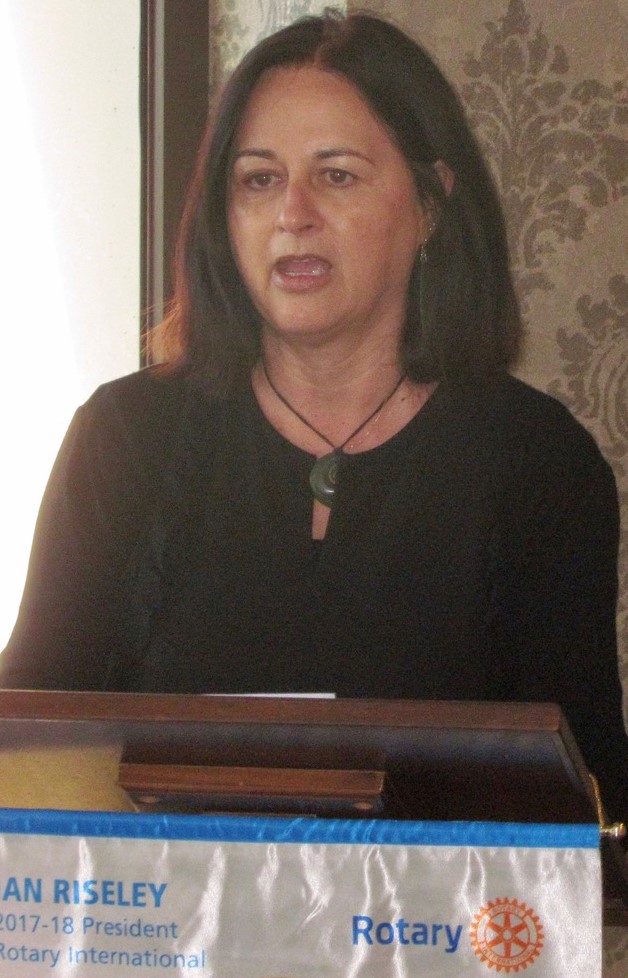
 Last Monday we were privileged to have Professor Tracey McIntosh talk to us about the Criminal Justice system. Her areas of research include incarceration and decarceration and she reminded us that New Zealand has one of the highest incarceration rates in the world and we also have one of the highest levels of racial disproportionality in the world.
She serves on numerous boards including the Department of Corrections Advisory Board; the Youth Crime Board and currently works largely with women in prison (at Wiri) and delivers a creative writing project there.
Her presentation was though provoking. NZ currently spends $1 billion a year on custodial lock-up. If the mega prison goes ahead, we will spend $2.5 billion. Tracey challenged us to think about the what it would mean to invest this money into another sector such as Health or Education. Would we expect good outcomes? Currently we invest hugely into the corrections system but expect very little from this investment. She challenged us to rethink the concept of Justice reinvestment and the impact of incarceration, which goes well beyond the person and into the community.
Shameful NZ statistics include:
- Maori represent over 50% of people in prison
- Of women in prison, 65% are Maori
- 92% of these women are aged between 16-25 years
- 75% of all women in prison have been diagnosed with mental health problems
- There is an 82% recidivism rate
The trajectory on exiting prison is very, very poor. She challenged policy makers to be careful not to have poverty of imagination and poverty of courage; but to work on what could allow flourishing. With imagination, social transformation is possible. This requires meaningful justice reinvestment – for example using money differently in the community.
Tracey suggested “Wouldn’t it be better to invest in safe warm housing to ensure people can flourish?” She also touched on our zero-tolerance policy on drugs and alcohol, of which action against the parents/adults largely ends up depriving their children.
Tracey talked about how funds could be given to communities who know their people and their needs - advising how with imaginative funding some social groups are already running programs that are assisting (for example) to reduce truancy; address suicide prevention; offer budgeting services; run homework schools; run workforce/leadership programs etc.
Reconceptualising justice and prevention is the key.Different responses are required for this e.g. decriminalising less serious crimes; recategorizing drug usage and crimes as health issues, rather than criminal.
Lack of time restricted Tracey from sharing much about the work she is doing via the Creative Writing Project in Wiri Prison, but she did read a very moving poetry response written by a young woman who is currently incarcerated.
Tracey left us with this sobering statement about our Criminal Justice System: “If we did nothing, we wouldn’t be worse than what we are doing at the moment”.